Does a Containerised Feed Plant make sense for what you have in mind?

Hennie Pieterse, hp dezign

Is a Containerised Feed Plant a solution for the application you have in mind?  Containerised feed plants are designed in a modular way, and normally contain all the plant equipment, electrical installation and process control equipment, assembled and installed into support structures the size of one or multiple standard 20 foot shipping containers.

Let’s consider the important advantages, features and characteristics of containerised plants in more detail:

1.  Process & Engineering Design and Functionality

Like we pointed out in one of our previous blogs : whether it is equipment or a processing plant, it is and should be designed to fulfil a certain function successfully.  At the same time we need to ensure the engineering design of the entire plant is done the right way.  A containerised feed plant ensures this responsibility is left to the supplier and his team.  Letting them specifying and supplying all the equipment required in the process as a containerised feed plant, leaves the customer with more time for marketing and general business development before the plant is established and commissioned.  A containerised plant also takes away the customer burden of ensuring that all equipment in the plant is a good match and that everything goes together well at the time of Installation.

2.  Environmental Impact, Health & Safety, and Food Safety

Consumer markets increasingly demand that food is manufactured in ways that ensure minimum environmental footprint,   while creating a safe and healthy workplace for people to work in.  A well designed containerised plant ensures all these issues are addressed by the supplier and that the final food or feed product is of highest standard and quality.

3.  Mechanical and Electrical Installation

Sourcing good quality equipment from one or more supplier is one thing.  Making sure that all these items are installed and assembled in a way that optimises plant performance while minimising capital investment and ongoing operational cost, is quite another.  In many countries mechanical and electrical installation expertise is not readily available.  This may leave the customer with a massive challenge installing all equipment in a professional and timely manner.  We have seen so many cases where customers thought they are saving money trying to do major installation tasks themselves, just to learn that there are many hidden costs and start up delays in doing so. A containerised plant eliminates all this uncertainty.   In a well designed containerised plant, all

    1. equipment,
    2. conveyors,
    3. electrical installation and
    4. process control devices

are installed and assembled at the point of manufacture before shipping takes place.

Cont feedmill 30 th ottevanger4.  Tested & Proven at point of manufacture

Many days and even weeks could be wasted as customers are trying to get badly designed conventional plants and equipment tested and fine tuned themselves before start up can take place.  Substandard electrical installation and process control systems normally contribute most to this situation.  All of this could be avoided with containerised plants as the supplier should test mechanical, electrical and process control installations at the point of manufacture.

5.  Reduced Installation Time on site

On site preparations such as foundations, floors and the actual building that will house the Plant are established while the containerised plant is manufactured.  Once the containerised feed plant arrives on site installation can normally happen in record time.  It is not uncommon to cut installation time by 60% to 80% in comparison to conventional plants.  In the case on conventional plants, unnecessary assembly and installation time and problems getting support structures, transitions, ducting, cabling and other mechanical and electrical materials and services concluded, may lead to hidden costs that are difficult to account for during planning of the project.

6.  No Support Structures required

One of the most beautiful features of a containerised feed plant is that no support structures are required.  The container sized structures that already contains the installed equipment, also serves as support structures for the entire plant.  Plant layout could be horizontal or vertical, and the “containers” are designed to be both structurally and functionally sound.

7.  Lower Building Costs

The containerised feed plant is housed inside a building that has to provide enclosure to the plant without the need to supply structural support.  This simplifies both the design and cost of the building required to house a containerised plant substantially.

8.  Lower Freight and Handling Cost

No special crating and shipping materials are required as the individual container modules are cladded with simple and cost effective sheets that meet shipping requirements.  Once onsite these sheets are simple removed during installation of the containerised modules.

9.  Containerised Plants for any Application

Any process could be designed as a containerised feed plant or at least as partly containerised, whether it is a simple cereal processing plant or a sophisticated compound feed plant.  Plants as small as 3 ton/h and up to 45 ton/h are feasible.

Still questioning whether a containerised plant is the right solution for your specific case?  Contact hp dezign today to discuss your specific case.  Together with suppliers such as Ottevanger and Inteqnion, we can ensure we come up with a design and supply solution that meets your specific needs.


Press Release : Intelscan restructured as Tovalia-Intelscan

Intelscan, the hp dezign Online Moisture Control Technology Supplier from Iceland underwent Structural changes.


hp dezign notifies all customers that our Technology Partner Intelscan restructured to form a new Company with greater capabilities serving our Customers.  A Company Spokesman says…..

“Intelscan is closing down operations in Iceland.  The company founder and inventor of the iScan system, Olafur Jonsson, relocated to France and opened a new company, called Tovalia-Intelscan sarl.  The new company will be even better positioned to serve the industry from a base in central Europe.  The product range has been expanded and further improved with additional effort in product development over the last 12 months.  Intelscan customers will be able to seek service from Tovalia-Intelscan sarl.  Please visit www.tovalia.com for further information about products that meet your needs.”


Great Opportunities for Vegetable Oils Down Under

Hennie Pieterse, hp dezign & Dr Sanjeev Agarwal, Technochem International Inc

We have the resources

Australia and other countries in the South East Asia Region are rich in vegetable oilseeds and therefore have great potential producing a range of refined vegetable oils.

Palm oil and palm kernel oil is in abundance all over Indonesia and Malaysia.  Australia is a prominent producer of canola oil, sunflower oil, cottonseed oil and soybean oil.  These sources of oil are available from both chemical and mechanical processing operations and find the following general applications in the food, feed and fuel industries:

  1. Animal Feed – some crude oil and refining byproducts go directly to the animal feed industry as energy source in compound feeds.
  2. Culinary Applications – for human food consumption either as salad dressing or as cooking oil.
  3. Industrial Use – for production of soaps, candles, perfumes, cosmetic products, paints and other industrial and neutraceutical products.
  4. Bio-Fuel – for production of biodiesel, which could be used like conventional diesel in engines.

Only a handful of crude vegetable oil producers add further value to it and normally just supply it  to other Oil Processors or sell it directly into the animal feed industry.  Many of these oil producers will be surprised to learn that it is not that difficult adding more value to crude vegetable oil.  Doing so can greatly expand their profitability.

Oil Refining Plant

Let’s add value to it

We need to refine vegetable oils and animal fats and oils before we can use them for cooking and frying purposes.  Vegetable oils, whether chemically extracted or mechanically pressed, contain impurities we have to deal with through “refining” before we can use it for application possibilities such as the ones outlined above.  Some of these impurities include Moisture, Solids (Insolubles), Gums (Lecithins), Free-Fatty Acids (FFA), Waxes, and Compounds of Sodium, Potassium, Magnesium, Calcium, and other metals.

Other characteristics of oils (such as colour, odour, and taste) are also considered impurities by modern consumers. These impurities are removed in a series of steps such as degumming (to remove gums), neutralizing (to remove FFA), bleaching (to remove color), deodorizing (to remove odor and taste), and de-waxing or winterization (to remove waxes).  Refined Oils are in general referred to as RBD (Refined, Bleached and Deodorized) Oil.  However, specific market or processing requirements may call for additional and very specific processing steps.  Some of the more vital oil processing steps could be described as follows:

Degumming – remove the gums present in crude oil.  Oils contain both hydratable and non-hydratable gums:

    1. Water Degumming.  Water is used to separate gums form the oil.  These gums could be dried and further processed to produce lecithin.
    2. Acid Degumming.  In this case, acids are used to separate the gums from oil.

Neutralizing – remove the FFA’s (Free Fatty Acids) from the oil.

    1. Physical Refining.  the FFA’s are evaporated from the oil under high temperature and vacuum.
    2. Chemical Refining.  This is the more traditional method using caustic soda (NaOH) in a process that removes the FFA’s.  This reaction produces soaps.  These soaps are separated from the oil but trace amounts still stays behind with the oil.  The oil is normally water washed or treated with silica to separate these trace amounts of soaps from the oil.

The Physical Refining Process is preferred because of the following reasons:

    1. it does not produce any soaps
    2. it recovers fatty acids in a more cost-effective way
    3. no chemicals are used

Bleaching – Vegetable oils contain colour pigments.  In many cases there are objections against the colour in some oils and bleaching becomes necessary to soften the colour.

Deodorizing – Vegetable oils also contain odours that may cause objection from the market.  Deodorizing is a steam distillation process that assists in stripping the oil from these unwanted odours.

Several other oil processing steps and techniques exist to address very specific requirements.

Biodiesel – Vegetable oils and animal fats are excellent raw materials for making biodiesel.  We will cover this very important topic in a separate blog.

Many opportunities exist for processing the range of vegetable oils we have available in our region.  We look forward to hearing what you think you can do with opportunities you have.  There are great opportunities for vegetable oils down under.  Please contact us should you like to discuss options in more detail.


Press Release : Technochem joins hp dezign Network as Supplier

The hp dezign Network of Suppliers expands further with the addition of Technochem International, INC.   Technochem is a specialist Engineering Company focussing on the design and supply of complete plants for Vegetable Oil Refining and Biodiesel Manufacturing.  Technochem has a 40 year history of supplying Oil Processing Solutions to customers world-wide.

Technochem

 Hennie Pieterse from hp dezign says : “ I know and worked with Dr Sanjeev Agarwal for 12 years and I am excited representing Technochem and helping customers in Australia, New Zealand and South-East Asia finding Oil Processing Solutions that can add value to their businesses”.

Understanding Customer Needs

Technochem’s approach to customer satisfaction is centered around the needs of Customers when establishing Oil Processing Solutions and include:

  1. Education
  2. Customized Design Solutions
  3. Capital and Operating Cost optimization
  4. Technical Advice
  5. Installation Supervision
  6. Commissioning and Training of Personnel
  7. After-Sales Support

hp dezign will play a key role in defining specific Customer Requirements and communicating potential solutions from the Technochem Team.

Typical Design and Equipment Supply Solutions

Careful assessment of the Project Scope leads to optimized design and equipment solutions for:

  1. Vegetable Oil Refining Plants
  2. Degumming Plants
  3. Bleaching Plants
  4. Deodorizing Plants
  5. De-waxing Plants
  6. Biodiesel Plants
  7. Esterification Plants
  8. Trans-Esterification Plants
  9. Methanol Rectification Plants
  10. Biodiesel Distillation Plants

Opportunities Down Under!

Australia, New Zealand and South-East Pacific produce vast quantities of Vegetable Oil ranging from Canola to Soy and Palm.  There are great opportunities for adding value to Vegetable Oils serving the Human Food, Animal Feed and Industrial Sectors.  Please visit the Technochem International, INC website or contact hp dezign to discuss your specific requirements.

Ottevanger exhibits at Grain Tech India 2013


Grain Tech India 2013 Invitation

Ottevanger will be present at yet another high profile Exhibition in Asia.  Please stop by to discuss your requirements or to learn how our Feed Milling experience of more than 100 years can benefit your company.  Detailed information about our Equipment and Feed Mill Design and Construction Services are available on our website at www.ottevanger.com

Loosing Process Moisture = Loosing Money!

Author : Hennie Pieterse

Prevention of unnecessary Moisture Loss during processing can save you THOUSANDS……and depending on your specific process, even HUNDREDS OF THOUSANDS of Dollars per year.

We all understand the pain and cost of buying a certain tonnage of Raw Materials just to sell less Final Product as a result of Processing Losses.  One such processing loss (and arguably one of the biggest contributors to Processing Losses) is MOISTURE LOSS!  Depending on your process, Process Moisture Loss may start taking place from the moment Raw Materials enter the Plant until the Final Product is bagged and stored.  We discussed the effect of unnecessary Moisture Loss in one of our previous Blog Posts:

  1. Operational Effect
  2. Nutritional Effect
  3. Economic Effect

We also discussed how proper Online Moisture Control Technology can help to combat this problem.

In today’s discussion, we want to briefly look at the potential Economic Effect of Moisture Loss.  Selling food and feed products at moisture content lower than what is necessary means the Processor is losing income as a result of unnecessary weight (moisture) loss.  This loss can very quickly & easily run into THOUSANDS and even HUNDREDS OF THOUSANDS of Dollars per year.

A Real Life Example

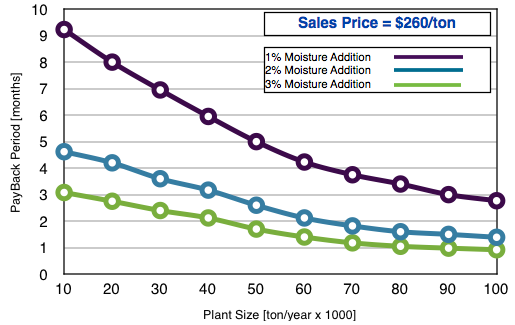
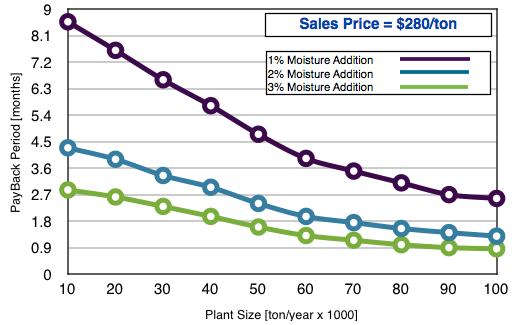
Let’s look at a real-life example to better understand the economic effect of Moisture Loss.  The following study shows the effect of several Operational and Commercial conditions on the Feasibility of a Typical Pellet Press Plant in Australia.  Assumptions are:

  1. Feed Mill Capacity [ton/year]                                   :              10,000 to 100,000
  2. Desired Target Moisture Content [%]                     :               10
  3. Moisture Addition required to reach 10% [%]       :               1 / 2 / 3
  4. Sales Price of Pelleted Animal Feed [$/ton]            :              240 / 260 / 280

Figures 1, 2 and 3 show the effect of the above assumptions on Payback Period** of the Investment required to install Moisture Control Technology.

Fig 1 : The effect of Plant Size & Moisture Addition on Payback Period**Fig 1 : The Effect of Plant Size & Moisture Addition on Payback Period

Fig 2 : The effect of Plant Size & Moisture Addition on Payback Period**Fig 2 : The effect of Plant Size & Moisture Addition on Payback Period

Fig 3 : The effect of Plant Size & Moisture Addition on Payback Period**Fig 3 : The effect of Plant Size & Moisture Addition on Payback Period

** Payback Period : Every company or business will have a minimum acceptable Payback Period. Payback Period gives a good indication of risk exposure. The longer a company must wait to recover its invested money, the greater the possibility of a calamity, and vice versa. The shorter the Payback Period, the lower the company’s exposure to such risk.

Logical Conclusions:

  1. For a 100,000 ton/year Feed Plant, producing Feed Pellets at moisture content just 1% below the ideal or Target Moisture Content (meaning 1% Moisture Addition in Fig 1, 2 & 3), results in Financial losses ranging from $240,000/year to $280,000/year.  These figures skyrocket to a maximum of $840,000/year when you produce Pelleted Feeds 3% below the Target Moisture Content.
  2. Larger Processing Plants will benefit the most from proper Process Moisture Management.  However, even smaller Plants show above average performance yielding Payback Periods ranging from 3 to 10 months.
  3. The benefit of proper Process Moisture Management is independent of Sales Price of Final Pelleted Feeds.
  4. There are some advantages not reflected in Figures 1, 2 & 3.  They are more difficult to quantify but include advantages such as optimized Final Product Quality and increased Plant Capacity.  These advantages are key to Market Expansion and Business Growth.

Process Moisture Auditing 

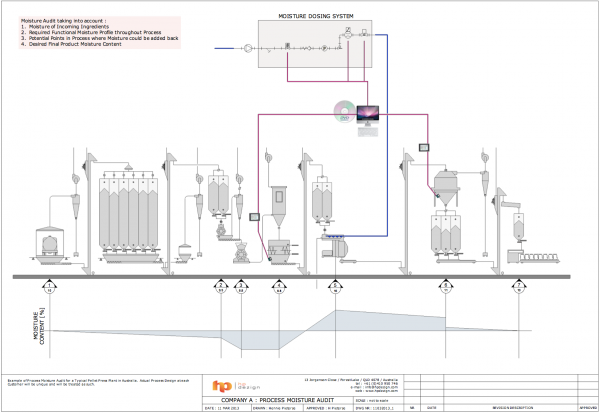
As we explained above, it is important to understand the Moisture Profile of a Food or Feed Process if we are interested in optimizing Operational, Nutritional and Economic Performance of a Processing Plant.  We do that by physically measuring the moisture content at critical points throughout the Process.  Once we have that in hand, we can compare it with the Target or Ideal Moisture Profile required throughout the process.  This information helps us to design a Moisture Control and Management System that will minimize Capital Investment while ensuring the Processor has no Processing Losses as a result of Moisture Loss.

Fig 4 : Typical example of a Process Moisture Audit MapFig 4 : Typical example of Process Moisture Audit Map

hp dezign supplies a turn-key service as well as all the equipment you need to start taking control of Moisture Management in your Plant.  Contact us today to get more detailed information about the study above.  We are also available to assist you in conducting a Moisture Audit of your Food or Feed Processing Plant.