We invite you stop by the Ottevanger Stand where our professional staff will be available to attend to your requirements. Visit Ottevanger for more information or contact your local Representative in Australia & New Zealand for assistance.
PTN joins successful Triott Group
Press Release
PTN joins successful Triott Group
…………..All disciplines for the mixed-food industry now under one umbrella
3 December 2012, Schijndel, The Netherlands. On 1 January 2013 the Triott Group – well known as the parent company of Ottevanger Milling Industry, Wynveen International, Inteqnion and TSC – will acquire a majority share in PTN in Schijndel (The Netherlands). Ernst Jan Ottevanger, director of the Triott Group: “This will make the Triott Group broader and more complete than ever.”
Innovation
The new collaboration with PTN is also attractive to customers of Ottevanger Milling Industry, Wynveen International, Inteqnion and TSC. Willem de Vaan, director of Wynveen International: “If you buy machinery from other companies, you have little influence over this. But by using the in-house expertise of each of our companies we can now modify the main machines for complete production lines. We have no doubt that this will shortly result in highly innovative projects,” says De Vaan.
Turnkey
Ernst Jan Ottevanger also believes that the collaboration will have major advantages on the international market. “This makes turnkey production, which is very popular abroad, increasingly easier. We now have everything we need in house,” says Ottevanger. PTN too can take on larger (turnkey) projects thanks to the collaboration. “In the past we restricted ourselves to just machinery sales and had to turn down requests for more wide-ranging jobs. But now we can take them on unhesitatingly,” says Van Benthum.
Doing business with trusted contacts
The Triott Group will consist of five equal subsidiaries. Each of the associated companies will retain its own identity, but at an international level they can call on support from each other. Marty van Benthum, director of PTN: “This structure, with equal companies together making up the Triott Group, is ideal. Our customers will continue to do business with their trusted contacts, while at the same time PTN – thanks to the support of the other companies – will be able to take on projects that were previously outside its scope, while retaining its own DNA.”
PTN
Since 1974 Pelleting Technology Nederland (PTN) has been a global player in the development, engineering, production, sale and servicing of pelleting presses and related machinery for the mixed-food, recycling and biomass industries. PTN is an expert in the conditioning, pressing and crumbling of feed. None of the other Triott Group subsidiaries has any in-house expertise in the production of the main machinery needed for this. This makes PTN a very valuable addition to the Group.
The Triott Group
The Triott Group specialises in the design and construction of machinery and installations for the cereal-processing and mixed-food industries. Over the last few decades the Triott Group has carried out a great many international projects : machinery and installations for mixed feeds, premixes, additives, fish food, pet food, flour mills and the processing of cereals and seeds. Ongoing research, active development and shrewd innovation ensure that the company retains its leading position in the international market.
Contact us today to find out how we can utilise the expertise & experience of the Ottevanger Group of Companies to find highly professional and cost effective solutions for your Food and Feed Processing requirements.
A Good Design?
Author : Hennie Pieterse
The question came up : What do we define as a good design?
Think of Structures, Devices, Machines, Facilities and other Engineered Products or Facilities found in Intensive Agriculture and Food Production. For any of these to be of “Good Design” there are at least the following Design Goals that should be met:
Functionality

A good example of a very well designed Hammer Mill by Ottevanger. It is equipped with Automatic Screen Changing Device and is a good example of a “Good Design” meeting all the Design Goals discussed in this Blog
This is arguably the most important design goal any design should meet. Especially if you want to call it a “Good Design”. Any Engineered Product has a function to fulfill, and it is very important that the Designers and Suppliers of such products, machines or facilities understand those functional requirements very well. Failure to create a design that meets functional requirements may make it useless. Even if the cost of such a design is low. And let’s face it : even a relatively “cheap” product could turn out to be “expensive” if it fails to do the job!
Engineering Integrity
The man on the street may associate this with “quality”. In Engineering Terms it means a Design that meets the Design Criteria for Structural Strength, Durability and the choice of Materials that will optimize Wear and other Operational Characteristics. Good Engineering Integrity is a reflection of the Professionalism of the Supplier who designed and built the Equipment or other engineered product
Cost
And of course a Cost as low as possible is important – but not at the expense of the other Design Goals in this Blog. Don’t be mislead by not understanding the full Cost implications, as it involves more than just the initial Capital Investment. Proper evaluation of
- Capital Cost,
- Operational Cost,
- and the Hidden Cost of After Sales Support (for example : downtime when you cannot get Spare Parts in time)
all adds up to give a true reflection of the real Cost!
Ergonomics
Whether Equipment, Machinery, or a complete Processing Plant, people will be involved in it. There will be Operators and Workers executing everyday tasks. People you rely on. People whose performance and commitment depend on the immediate environment they find themselves in. It is therefore important to work with Designers and Suppliers who ensure that the Equipment, Facilities, Processing Facilities and Spaces they design are Ergonomically acceptable, safe, user-friendly and pleasant.
After all, you need happy and motivated people to get the most out of your investment
Esthetics
Engineering Design is a beautiful thing….and a good design looks good! While investing the money achieving the Design Goals above, we may just as well make it look good. Architects and Automotive Designers are very good at that. There is no reason why Engineered Goods should be different.
So what is a “Good Design” then?…….a balanced blend of all the Design Goals mentioned above!
Contact us today to discuss your Design and Equipment needs. We Represent World-Class Equipment Suppliers and have a Team of Professionals that can help you maximizing your chances of being Commercially Successful.
The Importance of Moisture in Feed and Food Processing
Authors : Olafur H Jonsson & Hennie Pieterse
Everyone involved in Food & Feed Processing knows and understands the importance of processing at the correct moisture content. Moisture impacts processing in at least the following ways :
Operational Effect
In some processing steps, moisture at a certain level is required just to make that specific processing step works (for example, getting feedstock through a specific die size during Pellet Pressing).
Nutritional Effect
Moisture is vital in the Food-Chemical changes that take place and interaction between ingredients during processing, and therefore has a determining effect on Quality and Nutritional Value of the final product.
Economic Effect
Feed and Food Products are sold by weight. Producing food and feed products with moisture content too high may negatively effect quality and nutrition and even lead to Mould Growth and other moisture related problems. At the same time, selling food and feed products at moisture content lower than what is necessary means the Processor looses income as a result of unnecessary weight loss.
I asked my Industry Colleague at Intelscan, Olafur Jonsson, to explain the technical importance of Moisture Control in Food & Feed Processing in a bit more detail. This is what Olafur had to say:
Optimizing moisture content in feed and food processing is very important, especially from an economic point of view. Two factors make this optimization process even more important:
- Raw Materials (water included) have to be used efficiently during processing in order to minimize the cost of ingredients while maximizing income from sales of the final product.
- Energy prices continue to rise. This means the operational conditions of all equipment in the process need to be optimized to keep Drying Cost (if applicable) and other Operational Costs at a minimum.
Pellet Pressing is a good example. Correct Moisture Content of feed before pellet pressing will reduce the energy usage of the press. However, the added bonus of energy savings is that quality of pellets in terms of hardness and durability has been found to be improved when pressed at the correct moisture level. If the moisture content before the Pellet Press is too low, the following could result:
- Nutrients are lost as a result of the increased temperature in the Pellet Press.
- Moisture Content (and hence final product weight) is reduced as a result of elevated temperatures inside the Pellet Press.
It is therefore important to compensate for moisture loss during Grinding, Cooling and other processing steps in order to maximise output in terms of
- Utilization Efficiency of Raw Materials
- Energy Savings
- Better Physical and Nutritional Quality of final product
An Innovative Solution
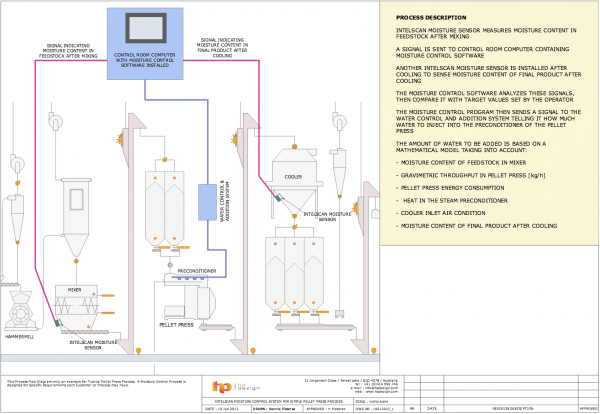
New Technology makes it easier for the Food or Feed Processor to control moisture during processing. It involves an Online Moisture Sensor that “scans” the moisture content of feedstock instantly and continuously as it flows past the point of measurement.
The solution provided by Intelscan is based on Microwave Technology. The advantage of Microwave Technology compared to the NIR (Near Infrared) system is that microwave technology is not affected by other constituents such as Fat or Protein. This means that many different foods or feeds with various recipes or formulations could be measured and controlled without complicated calibration work.

The Intelscan Online Moisture Sensor monitors moisture, temperature and in some cases density on a continuous basis. These signals are interpreted by Tovalia Software installed on a computer in process control room of the feed mill or food processing plant. The interpreted values are then used to control one or multiple Moisture Dosing System(s). The Moisture Dosing Systems introduce water back into the process at a point where it is of
– Operational,
– Nutritional and
– Economic
importance.
The Target Moisture Content at any point during the Process is set and controlled by the Feedmill Operator(s).
Moisture Sensing and Control Systems are designed with specific process requirements in mind.
We invite you to contact us for more information how we can help you control Process Moisture and reduce Processing Costs.